
Beyond ‘Zero Harm’: Advanced Geotechnical Solutions for Open-Pit Slope Stability
The Australian mining industry is built upon the foundational culture of ‘Zero Harm.’ However, achieving absolute safety in the dynamic environment of an open-pit mine requires more than administrative protocols; it demands rigorous geotechnical engineering. As pits go deeper to access high-grade ore, the complexity of wall stability increases exponentially, making advanced geotechnical solutions critical.
Rethinking the Factor of Safety
Slope design is a delicate balance between safety and economics. The fundamental principle is the Factor of Safety (FoS), defined simply as the ratio of resisting forces to driving forces:
FoS=τmτf
Where τf represents the shear strength of the rock mass, and τm represents the mobilized shear stress. While an FoS of 1.2 to 1.3 might be acceptable for temporary bench scales, overall pit slopes often require a more comprehensive probabilistic approach. Deterministic models are no longer sufficient; incorporating the Probability of Failure (PoF) through advanced numerical modeling is now the industry standard.
Real-Time Monitoring and Risk Mitigation
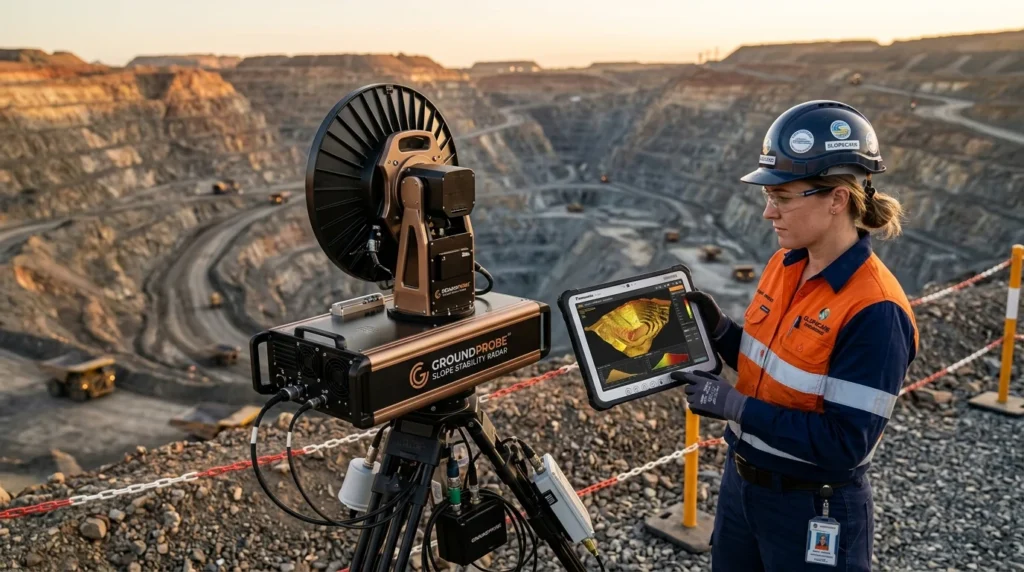
Modern slope stability relies heavily on real-time data acquisition. The integration of Slope Stability Radar (SSR), automated total stations (ATS), and drone-based photogrammetry allows geotechnical engineers to detect sub-millimeter displacements. When combined with predictive kinematic analysis, these tools empower operations to establish early warning systems, safely evacuate personnel, and adapt mine plans dynamically.
The TerraSolve Advantage
At TerraSolve, we provide advanced geotechnical analysis that goes beyond standard reporting. Our engineers utilize state-of-the-art 3D modeling and structural mapping to optimize your pit slope designs—ensuring maximum ore recovery without compromising the ‘Zero Harm